
Is there a federal inheritance tax? In general, no. The federal government does not impose an inheritance tax on a person simply for receiving property from someone who died. The federal tax people often mean is the estate tax, which is assessed on an estate rather than charged directly to each heir. That distinction matters when a family member leaves you money, property, or a business interest.
Talk with LedgerWay about your tax questions
For business owners, the question rarely ends with the name of a tax. An inheritance may involve an ownership transfer, a property sale, continuing business income, or records that must be kept for later tax reporting. The right next step depends on what passed to you, how the estate handled it, and what you do with it afterward. This guide explains the federal distinction, outlines the records to gather, and shows when a tax professional can help you sort out the moving parts. It is general information, not legal or tax advice for a particular estate.
What Does “Federal Inheritance Tax” Mean?
People use “inheritance tax” as a broad label for taxes connected with death. In the federal system, however, the key distinction is who is taxed and what event is being taxed. An inheritance tax is generally a tax imposed on a recipient because they received property from a deceased person. The federal tax most often discussed in this context is instead the estate tax: a tax connected to the transfer of property at death and calculated at the estate level under federal rules.
The U.S. Department of Agriculture describes federal estate tax as part of a system of transfer taxes that applies to property transferred at death. Cornell Law School’s Legal Information Institute also explains the estate tax as a tax on the transfer of a person’s estate at death. These descriptions help explain why receiving an inheritance and an estate owing tax are not the same event. The estate tax rules and any filing requirement depend on the estate and the law applicable to the relevant year.
That difference has a practical consequence: an heir generally does not calculate a federal inheritance tax just because a distribution arrived. But the inheritance can create other tax questions. A later sale may produce a gain or loss. A business or rental property may generate income. An inherited retirement account can have its own distribution rules. Treat each asset and each later transaction separately rather than assuming that the entire inheritance is either taxable or tax-free.
For background, see the USDA overview of federal estate taxes and Cornell Law School’s estate tax explanation. Neither overview replaces a review of the facts and rules for a specific estate or tax year.
How Is Estate Tax Different From Income Tax on an Inheritance?
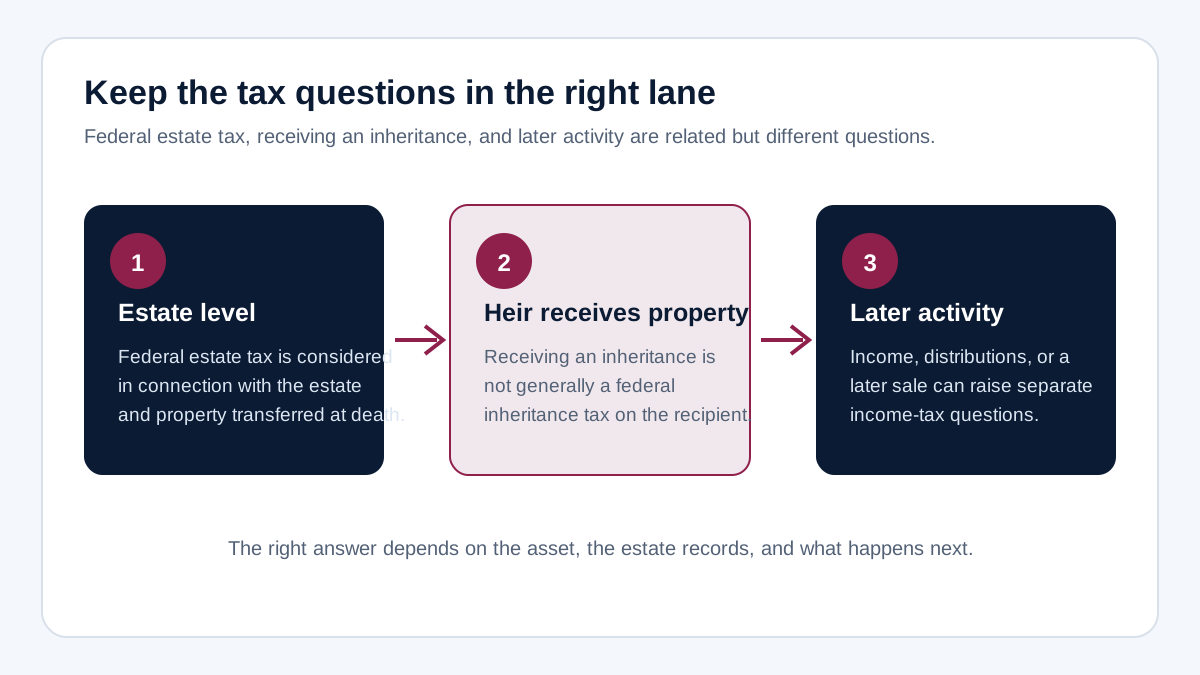
It helps to separate three questions that often get blended together:
- Did the estate owe federal estate tax? This concerns the estate and its assets under federal transfer-tax rules. The person responsible for administering the estate should determine whether a return or payment is required.
- Did you receive property as a beneficiary? Receiving an inheritance is not, by itself, the same as receiving wages or business revenue. There is no general federal inheritance tax imposed on the recipient simply for inheriting.
- Did the property or money generate taxable income later? Interest, dividends, rental receipts, business earnings, distributions from certain accounts, or a later sale can raise separate income-tax questions. The answer depends on the asset and the circumstances.
For example, suppose you inherit a share of a family business. The transfer of the ownership interest is one issue. The company’s income after the transfer, distributions paid to you, and any later sale are separate issues. The same distinction applies to a home that is rented after an inheritance or investments that remain in an account and earn income.
Do not treat an estate distribution statement as a complete tax analysis. It may show what you received without explaining how a future sale, distribution, or business transaction should be reported. Keep the paperwork and ask questions before making a major transaction.
Who May Need to Address Federal Estate Tax?
The federal estate tax is generally an estate-level concern, not a tax bill sent to every beneficiary. The estate’s representative or executor typically coordinates the estate’s tax work with the appropriate legal and tax professionals. Whether the estate must file a federal estate tax return or pay tax depends on the estate’s value, deductions, transfers, prior planning, and the rules in force for the year of death.
Thresholds and other provisions can change over time. Do not rely on an old article, a past return, or a remembered exemption amount to decide what applies today. A family that has dealt with an estate before may still need to check the rules for a new event. For related planning context, see LedgerWay’s year-end tax moves guide. Likewise, a large-looking estate does not automatically mean a tax is due; deductions and other facts can affect the result. A small-looking estate should not be assumed to have no filing or recordkeeping tasks without checking the rules.
An executor may also need to distinguish federal estate tax administration from the deceased person’s final income-tax return and any returns for an estate or trust. Those filings address different taxpayers and different periods. If you are a beneficiary and do not know whether the estate filed a return, ask the executor or estate attorney what documents are available and who is handling tax matters.
LedgerWay provides business tax preparation and tax planning and preparation support. A professional can help identify the business and income-tax questions within that scope; legal questions about wills, trusts, or administration belong with an appropriate attorney.
It is also useful to ask what “the estate” means in the document you are reading. People may use the word to refer to the property and obligations being administered, the person handling that administration, or a separate estate or trust that may issue tax documents. Those are not interchangeable. A letter from an executor, a tax form from an estate, and a statement from a financial institution can describe different parts of the process.
Keep in mind that federal estate-tax law is only one part of the picture. State rules, the decedent’s residence, the location of property, and the way an asset was titled can affect the questions professionals need to examine. This guide focuses on the federal distinction and does not attempt to determine state liability or explain the legal effect of a will or trust. If several states or a trust are involved, say so at the beginning of a consultation rather than assuming the federal answer resolves everything. Business owners can also review LedgerWay’s small-business growth guidance as they plan ongoing operations.
Which Tax Questions Can Arise After You Receive an Inheritance?
The type of asset often matters more than the fact that it came from an estate. Start by listing each asset, the date it transferred, the person or entity that transferred it, and what you have done with it since. Then identify whether it has generated income, been sold, or become part of a business activity.
| What you received or did | Question to check | Records to gather |
|---|---|---|
| Cash or a direct distribution | Was this an inheritance distribution, or does it include income or another type of payment? | Estate distribution statement, correspondence from the executor, and deposit records |
| Investments or other property | Did the asset generate income, and are you considering a sale? | Transfer documents, account statements, valuation information, and sale records |
| Real estate | Will you occupy, rent, maintain, or sell the property? | Deed or transfer papers, property records, rental records, and improvement receipts |
| A business interest | What rights and responsibilities transferred, and how will ongoing activity be reported? | Ownership documents, operating agreement, books, prior returns, and distribution records |
| A retirement or similar account | What beneficiary distribution rules apply to this specific account? | Account statements, beneficiary paperwork, plan documents, and custodian notices |
The table is a starting checklist, not a conclusion about taxability. For example, an inherited asset may have a tax basis that affects a later sale, but basis rules depend on the asset and facts. Do not assume the amount shown on a distribution statement is the basis to use. Ask for relevant valuation and transfer records, and have the tax treatment reviewed before filing a return that reports a sale.
There can also be a difference between money paid to you as a beneficiary and income that belongs to an estate or trust. An estate or trust may provide tax documents describing income allocated to a beneficiary. Read those documents carefully and pass them to the person preparing your return. If a document arrives after you have filed, ask a tax professional whether any corrective action is needed.
What Should a Business Owner Do With an Inherited Business Interest?
An inherited ownership stake can make personal tax questions overlap with day-to-day company accounting. Before changing the books or taking money out of the business, confirm what ownership was transferred and when. Review the governing documents, ownership ledger, buy-sell arrangements if any, and any instructions from the estate. The legal effect of those documents is a question for an attorney, but accurate copies help the tax and accounting work stay grounded in the same facts.
Next, clarify how the business will handle activity after the transfer. Who can approve transactions? Who receives distributions? Has the company updated its records to reflect the new owner? Which reporting documents should be sent to the beneficiary? These operational questions can prevent an inherited interest from becoming a bookkeeping mystery months later.
Keep personal and business activity clearly separated. Do not put an inheritance distribution into the company’s sales or revenue simply because the beneficiary is an owner. Likewise, do not treat a company payment as a personal inheritance without understanding what it represents. Record the transaction according to its substance and supporting documentation, and have the responsible adviser review any uncertain classification.
For ongoing records, bookkeeping support can help keep business transactions organized. If the transition changes the company’s reporting or planning needs, fractional CFO services may be relevant to broader financial decision-making. These services do not replace estate counsel, and the right support depends on the business’s needs.
Consider a common sequence: a beneficiary receives a business interest, the company continues operating, and the beneficiary later receives a distribution. Treat each event as its own entry in the chronology. The transfer document supports the change in ownership; company books support operating income and expenses; and the distribution record explains the payment. A single bank deposit cannot establish how all three events should be classified.
Another example is inherited real estate. The transfer paperwork, property records, rental activity, and eventual sale documents answer different questions. If the property is rented, keep a record of the dates it was available and used, income received, and expenses paid. If you later sell, retain the closing statement and records of relevant improvements. Do not rely on memory to reconstruct these details years later.
When the estate has multiple beneficiaries, save communications that explain how shared assets are being managed and how distributions were calculated. If one person pays an expense on behalf of the others, document the payment and the agreement about reimbursement. Clear records can help the tax preparer understand the transaction without guessing at the family’s intent. If beneficiaries disagree, seek legal guidance rather than attempting to resolve a legal dispute through accounting entries.
How Can Heirs Organize Records Before Filing?
Good records make it easier to distinguish an inheritance from later income and to answer questions about a transaction. Create one folder for estate and transfer documents and another for activity after you received each asset. Keep digital copies in a secure location, but retain originals when the executor or adviser says they are important.
- Ask for an asset-by-asset inventory. Record what you received, the transfer date, and whether the asset came directly to you or through an estate or trust.
- Request supporting statements. Obtain distribution statements, account histories, property records, and any tax documents issued by the estate, trust, custodian, or business.
- Track activity after transfer. Keep records of income, expenses, contributions, distributions, improvements, and sale proceeds. Note the date and purpose of each transaction.
- Separate personal and company records. If a business interest is involved, retain company records in the company’s bookkeeping system and personal inheritance papers in your own files.
- Write down open questions. Ask which professional is responsible for each item, such as the estate return, a final income-tax return, business reporting, or a future sale.
This process is especially useful when the estate closes over a period of time or when several beneficiaries share an asset. Keep a simple chronology: date of death, dates of transfers, dates documents arrived, and dates of major decisions. If you receive conflicting figures, do not choose one without explanation. Ask the source of each figure and what it represents.
Owners who already use a financial planning process can add the new asset and any resulting obligations to it. LedgerWay’s small-business tax planning guide offers a broader framework for connecting business decisions with tax preparation. For questions that involve both company finances and an inheritance, bring the relevant records together rather than treating the two topics as unrelated.
When Should You Ask for Professional Help?
Get advice before acting when the estate or inherited asset raises a question you cannot answer from the documents. That may include a business transfer, a planned sale, rental activity, a tax notice, a disputed valuation, or a form from an estate or trust that you do not understand. Timing can matter, so do not wait until a return is nearly due to discover that important documents are missing.
Prepare a concise packet before your meeting: a list of assets, the transfer documents you have, any estate or trust tax forms, business records, and a short list of intended actions. Tell the adviser whether you have already sold property, received income, changed business records, or filed a return. That context helps the adviser identify which questions are about the estate and which concern you or your company.
Check that the professional’s role matches the question. Estate attorneys address legal rights and administration. A tax professional can review tax reporting and filing questions. An accounting team can help organize business records and understand how ongoing company activity is reflected in the books. Some situations require coordination among more than one professional. For general information on LedgerWay’s approach, see about LedgerWay and its accounting and advisory services.
When you contact an adviser, ask who will handle the federal estate-tax question, whether a separate income-tax return is involved, what records are still needed, and what deadlines the responsible professional is tracking. Those questions clarify ownership of the work without assuming that one person or firm handles every legal, estate, and business matter.
Contact LedgerWay about business tax and accounting support
Frequently Asked Questions
Do I pay federal tax just because I received an inheritance?
Generally, no federal inheritance tax is imposed on a person solely for receiving an inheritance. But income generated by an inherited asset, certain account distributions, or a later sale may create separate tax questions. Keep the transfer documents and ask about the specific asset and transaction.
Is federal inheritance tax the same as federal estate tax?
No. An inheritance tax is generally described as a tax on the recipient, while federal estate tax concerns the estate and property transferred at death. The estate’s filing and payment obligations are separate from any income-tax reporting a beneficiary may have later.
Can an inherited business create tax work even if I did not sell it?
Yes. Ongoing business income, distributions, ownership records, and reporting documents can all require attention even without a sale. Keep personal and company transactions distinct and have the business’s tax and accounting treatment reviewed.
What should I do if I do not know whether the estate filed a return?
Ask the executor or estate attorney what filings were considered or completed and request copies of relevant records. An heir should not assume the estate had no filing requirement simply because no tax bill arrived. A qualified tax professional can review the facts and current-year rules.
Does the federal answer settle whether any tax applies?
No. The federal distinction does not answer every question about state taxes, estate administration, income from inherited assets, or later transactions. Check the rules relevant to the estate and your circumstances with a qualified professional.
Keep the Transfer and the Follow-On Activity Straight
The short answer to “Is there a federal inheritance tax?” is generally no: federal law focuses on estate tax at the estate level rather than a tax charged to each person simply for receiving inherited property. The next questions concern what you received, what the estate reported, and what happened after the transfer. Organize the records, keep business activity separate, and get help before a major sale, distribution, or ownership change so that each tax question is addressed in the right place.