
An IRS letter does not mean you did something wrong. It means the agency wants to check that a return matches the records behind it. This IRS audit preparation guide covers how returns get selected, which kind of exam you are in, which records to gather, and how the review ends. The goal is a clear file and a calm response, not a scramble.
Schedule a consultation with LedgerWay
If the notice just arrived, start with the response date and the facts on the letter. The live first response to an IRS audit notice covers that opening triage. This guide picks up once you know the deadline and need to build the rest of the case.
What Does an IRS Audit Preparation Guide Cover?
An audit, which the IRS also calls an examination, is a review of books, accounts, and financial records. The agency checks that the return follows the tax law and that the tax reported is correct. Selection itself is not a finding. Plenty of exams end with the return accepted as filed.
A useful IRS audit preparation guide answers four questions before you touch a receipt. Write the answers down so the rest of the file stays inside the notice.
- Why might this return have been selected?
- Is the exam by mail, at an IRS office, or in the field?
- Which items on the return does the notice actually ask about?
- What does a finished exam look like if you agree, disagree, or nothing changes?
Keep the scope tight. The notice names the year, the form, and the items under review. Prepare those items. Do not rebuild the whole history of the business unless the letter asks for it.
How Does the IRS Choose Returns to Examine?
The IRS describes a few selection paths, and none of them is a secret score you can reverse-engineer from a blog. Knowing the paths still helps, because it stops you from inventing a story about why you were picked.
Random selection and computer screening
Some returns are chosen by a statistical formula. The IRS compares a return with norms built from audits of similar returns under its National Research Program. That program updates the information used to select returns. A return can land in this group with no special red flag attached.
Related examinations
Your return can also be opened because it shares an issue or a transaction with someone else whose return was already selected. Business partners and investors are the examples the IRS gives. If a partner was examined, your shared numbers may be next, even when your own return looked ordinary.
What selection is not
Filing an amended return does not change how the original return was selected. Amended returns go through their own screening, and an amended return can be examined on its own. A refund is not, by itself, a reason for an audit. The IRS audit overview is the source for these points.
Year-round habits still matter more than guessing at a score. Clean books and a return that matches them are the preparation you can actually control. That is the same discipline behind year-round tax preparation for a small business.
Which IRS Audit Type Do You Have?
The notice tells you how the exam will run. The IRS starts by mail. It does not open an audit with a phone call. Read the letter for the format, the items requested, and the response date before you call anyone.
| Exam type. | Where it happens. | What you typically prepare. |
|---|---|---|
| Correspondence, by mail. | You send copies to the address on the notice. | Support for the income, expenses, or deductions named in the letter. |
| Office audit. | An in-person interview at an IRS office. | The records requested, organized so you can walk through them. |
| Field audit. | Your home, your business, or your accountant’s office. | A broader set of books when the issues or the records are extensive. |
A mail exam asks for more detail on certain lines, such as income, expenses, or itemized deductions. If the books are too large to mail, you can ask for a face-to-face review. The letter includes the contact path for that request. The Taxpayer Advocate Service says the IRS conducts audits by mail or in person, and that a mail letter names the items under review, what to send, and where to send it.
Office and field exams are both in person. The difference is location and, often, scope. An office exam is at an IRS office. A field exam is at your home, your place of business, or your representative’s office. Field work tends to show up when the records are extensive.
Which Records Should You Gather?
The IRS asks for documents you already used to prepare the return. The request should not make you create something new. Match each line in the letter to the record that supports it, and stop there.
Build the file around the notice
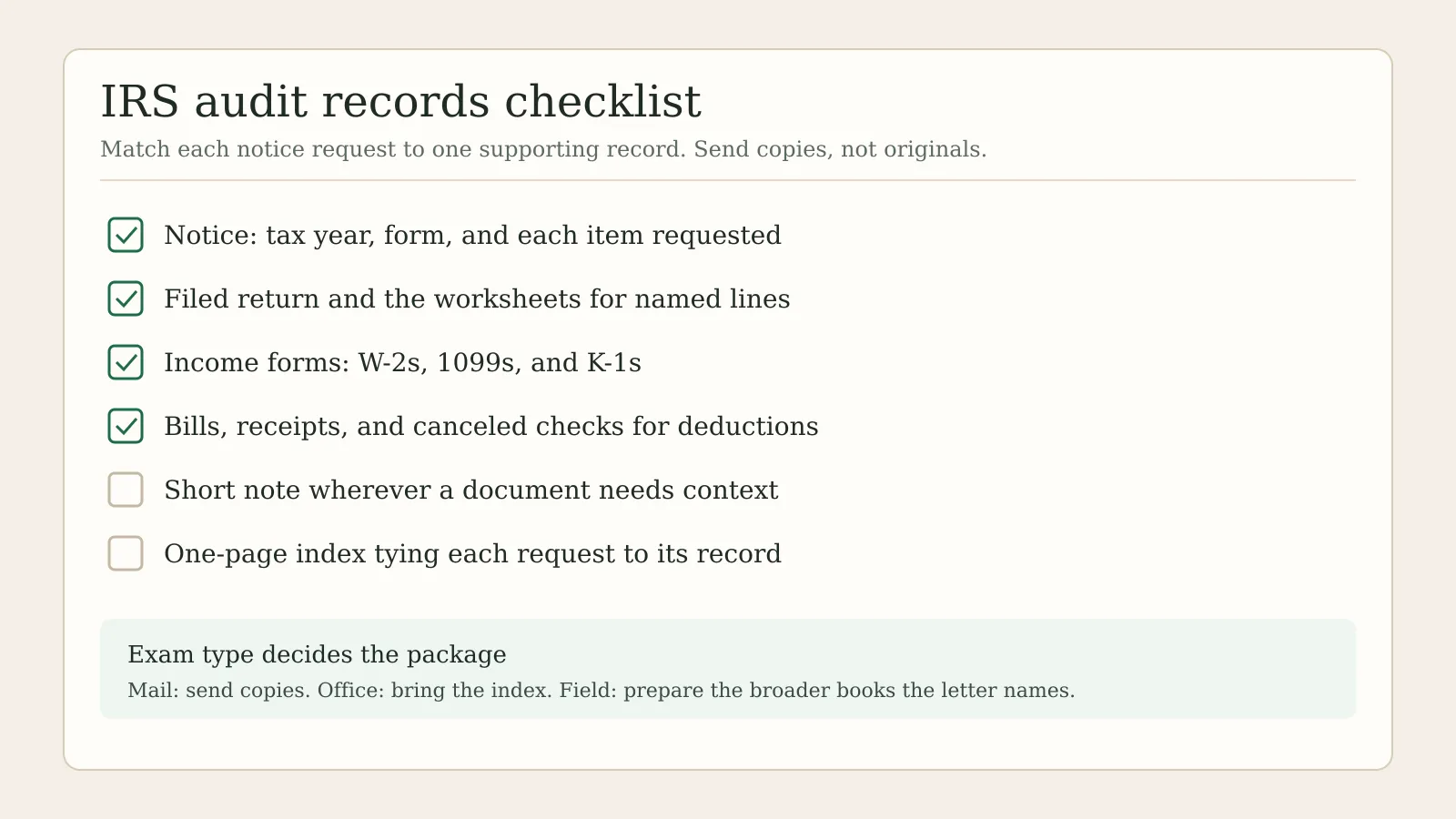
Work in this order so each request in the letter has one home in the file. Do not skip ahead to documents the notice did not name.
- Copy the notice and highlight the tax year, the form, and each item requested.
- Pull the filed return for that year and the worksheets behind the lines named in the letter.
- Match income to the forms that reported it, such as W-2s, 1099s, and K-1s.
- Match deductions and credits to the bills, receipts, and canceled checks that support them.
- Add a short note wherever a document needs context, such as what the expense was for.
- Make a one-page index that lists each request and the record that answers it.
Organize by year and by type of income or expense. A simple transaction summary helps the reviewer see the total without opening every page. The IRS records-request guidance says to include explanations with the documents and never to mail originals. Send copies. Keep the originals in your own file.
What often gets requested
Common items include receipts, bills, canceled checks, legal papers, loan agreements, logs, tickets, employment documents, and Schedule K-1s. Medical, insurance, or loss records come up only when those items are on the return under review. You do not send the whole archive.
Electronic records are accepted where the IRS can use them. If a bank or app holds the history, export the period the notice names and label the file with the year and the line it supports.
How long records need to exist
Keep the records you used to prepare the return for at least three years. The IRS says exams usually look at returns filed in the last three years. If the exam finds a substantial error, it may open additional years, but it generally does not go beyond six. That is a recordkeeping rule, not a reason to panic about older closed years.
IRS Publication 583 is the plain-language starting point for the records a business should keep. The recordkeeping page covers how long to hold them. Strong bookkeeping for a growing business is what makes this folder easy to build when a letter arrives.
How Should You Handle the Interview or Mail Response?
Preparation is mostly sequencing. Answer what was asked, in the format the notice describes, by the date it gives. A tidy file beats a long explanation.
Respond to the items named
For a mail exam, send copies to the address on the letter, with your index on top. For an office or field exam, bring the same index and the copies, and be ready to explain each one in a sentence or two. Stick to the year and the issues in the notice. If you do not know an answer, say you will confirm it from the records rather than guessing.
If you need more time, use the contact instructions in the letter and ask before the due date. Silence is not a strategy. The IRS page on audits explains what happens when a response is late, and the notice itself is the authority for your deadline.
Know the window you are in
The statute of limitations is the legal clock on assessment. The IRS can ask to extend it so there is time to review documents, consider an appeal, or process a refund. Read any extension form before you sign it, and ask what extra time it actually adds. You do not have to decide that alone.
Representation is a separate decision from preparation. If the issues are wide, the records are scattered, or you disagree with where the exam is heading, talk with someone who can stand in for you. IRS audit representation is that conversation. This guide stops at getting the file and the facts ready.
How Does an IRS Audit End?
The IRS describes three outcomes. Knowing them keeps the middle of the exam from feeling open-ended. You can see which finish line you are walking toward.
- No change. The return is accepted as filed. You may still want to tighten the records that were hard to find.
- Agreed. The IRS proposes changes and you agree. The changes can affect tax due or a refund.
- Disagreed. You do not accept the proposed changes. You still have a path to respond, including appeal rights described in the closing letters.
The Taxpayer Advocate Service puts the same finish line in plain words. The IRS may accept the return as filed or propose changes. Proposed changes can move what you owe or what you are refunded. Read the report against your index before you sign anything. If a figure does not match a record you provided, ask about that line specifically.
You might have missed the original exam. You might have moved and never seen the letters. Or you might now hold documents you did not have then. In those cases, the Taxpayer Advocate Service describes audit reconsideration as a later look. That is a backup, not a plan. A complete response the first time is still the better path.
How Do You Stay Ready After the Exam?
The best preparation for the next filing season is whatever this exam made hard. If a deduction took a week to support, the receipt process needs a home. If income on a 1099 did not match the books, the monthly close needs a check against those forms.
Three habits cover most of what an exam tests. None of them requires a special system, only a habit you keep when nobody is asking.
- Close the books on a schedule so income and expenses are not reconstructed at tax time.
- Tie the return to those books, line by line, while the year is still fresh.
- Save the support with the return, labeled by year and by line, for at least three years.
Owners who want that rhythm looked after, rather than rebuilt under a deadline, can fold it into ongoing accounting work. Business tax preparation is where the return gets built from those records. When the questions are about cash, margins, and what the numbers say for the next quarter, CFO advisory for a growing business sits alongside the compliance work.
LedgerWay works with small businesses, professionals, and high-net-worth individuals from Atlanta and virtually. The point of preparation is the same in every case. You should be able to show how a number got onto the return without rebuilding the year from scratch.
Schedule a consultation with LedgerWay
Frequently Asked Questions
Does an IRS audit mean I made a mistake?
No. The IRS says selection does not always mean there is a problem. Returns are also chosen through random statistical screening and through related exams of partners or investors. Many exams end with no change to the return.
Will the IRS call me to start an audit?
No. The IRS notifies you by mail and does not start an audit by telephone. The letter has the format, the items requested, and the response date. Treat unexpected calls about a new audit as something to verify against that letter.
How far back can an IRS audit go?
Exams usually cover returns filed within the last three years. If a substantial error turns up, the IRS may open more years, but it generally does not go past six. Keep the records behind each return for at least three years.
Should I send original documents?
No. Send copies, never originals. Organize them by year and by type of income or expense, and add a short note when a document needs context. Include an index that ties each requested item to the page that supports it.
What are the possible results of an audit?
Three results are standard. No change means the return stands. Agreed means you accept the IRS changes, which can affect tax due or a refund. Disagreed means you do not accept the changes and can pursue the response path in the closing letters.
Get Your Records Ready Before the Deadline
An exam rewards a file that matches the notice. Know the exam type, gather only the records the letter names, and keep copies of everything you send. If you want a second set of eyes on the response before it goes out, LedgerWay can walk through it with you.